
Author: latahrecoverycenter
So Annoying!
by Nancy Casey
Water is essential for life. It makes up a big part of our bodies. We bathe in it and cook with it. Rain nourishes the crops that feed us.
Nothing is perfect, though. Today, write a page about how annoying water can be.
When has water made you (or someone else) grumpy or ruined your day? Think about that while you settle in to write and set up your page.
Get out your writing stuff. Arrange the things in front of you in a way that looks pleasing to you. Take a breath or two. Wiggle around a little to loosen yourself up.
Draw a line at the top of a blank page where your title will go. Set aside some space for illustration if you like. Start drawing or doodling in it if it helps your mind focus.
Water can be annoying when it is in the wrong place—on a library book, in your shoes, or dripping from the ceiling, for example.
Have you ever suffered from a problem that was caused by too much water? Do you have a story about a time when it rained at the worst possible moment?
Sometimes perfectly good water can be ruined when something gets into it—rust, microbes, or chemicals, for example. What annoyances does contaminated water bring about?
When water leaks, what are some of the annoying places it might go?
When water is in the form of a gas or solid, it can be annoying in ways that liquid water isn’t. Do you have a story of a time when water vapor, steam, or ice messed up your day?
As soon an idea or story about water being troublesome comes to mind, start writing about it. As more thoughts pop up, write them down, too. Try to fill the whole page without pausing. If you have to wait for your next idea to arrive, draw or doodle somewhere on the page. That will help you stay focused and open-minded at the same time.
When you get to the bottom of the page, look back over your work. Pause to add illustration or decoration if you like.
Do your ideas form any kind of a pattern? Do they seem to be about a bigger idea that you hadn’t really planned on writing about? If they do, maybe you can use that insight to think up a title. If they don’t, make up some kind of a title anyway and write it at the top of the page.
Put your initials or a signature on the page, too. And write the date on it. Here is an example of what someone could write.
You can share your work by posting it as a comment below. You can type it in, or take a photo of it and upload the image.
———-
Nancy Casey has lived in Latah County for many years. You can find more of her work here. If you would like some help with your writing, contact Nancy or the Latah Recovery Center.
Recovery Radio 7/7/2022
The Perfect People
by Nancy Casey
You probably don’t know any Perfect People and it’s pretty likely you aren’t one yourself.
When we observe people’s shortcomings (or our own) we make a comparison to a standard that only a Perfect Person can meet. Whether Perfect People exist or not.
In your writing today, bring the Perfect People to life in your imagination.
What do you suppose the Perfect People are doing right now? What are their homes like? What kinds of things do they say? What will they never do?
Conjure up the Perfect People in your imagination while you get yourself ready to write. As you get out your stuff, think about all the perfect writing stuff a Perfect Person probably has.
As you relax and clear your mind to write, heave a big sigh for all the mistakes a Perfect Person never would make.
Draw a maybe-perfectly straight line across the top of the page where your maybe-perfect title will go. Mark off some space that you will use for a maybe-perfect drawing. (Or scribbling—is it possible to scribble imperfectly?)
What are Perfect People like? What do they dream about? Do they ever worry?
As soon as an idea about a Perfect Person pops into your mind, write it down.
You can write about what you would be like if you were perfect. Or the perfect way that others could behave around you. Maybe you will start thinking of all the skills and qualities that Perfect People have.
When your page is full—perfectly full, perhaps—read over what you have written. Make corrections or changes if you like. Do your notice that your ideas have formed some kind of pattern? Do they seem to be about a general idea that you hadn’t really planned on writing about? If they do, maybe you can use that insight to think up a title. If they don’t, make up some kind of a title anyway. It doesn’t have to be perfect.
While you are reviewing what you have written and thinking up a title, you can draw or doodle on the page.
When you feel like the page is completely finished, put your initials or a signature on it somewhere, along with today’s date.
Here is an example of what someone could write.
You can share your work by posting it as a comment below. You can type it in, or take a photo of it and upload the image.
Nancy Casey has lived in Latah County for many years. You can find more of her work here. If you would like some help with your writing, contact Nancy or the Latah Recovery Center.
Oxford House Application
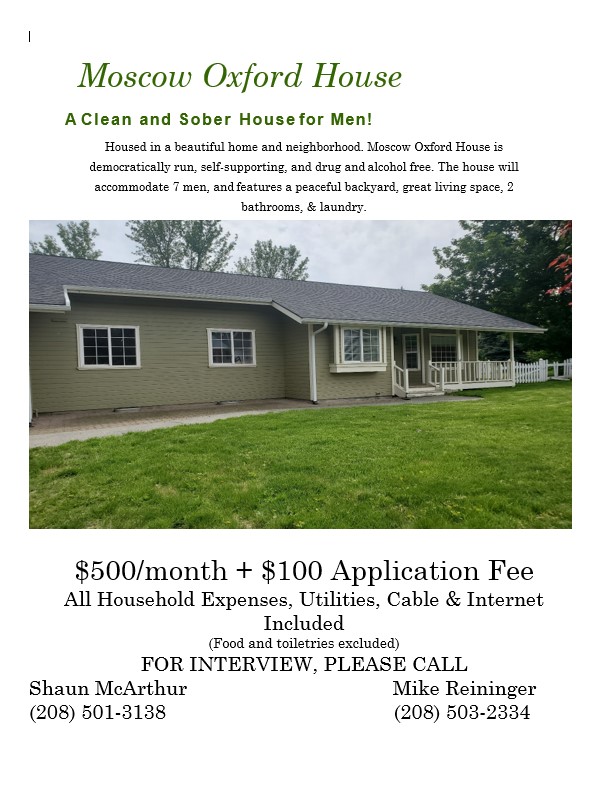
Oxford House Opening in July
Quality Comparisons
by Nancy Casey
Begin by setting up your page. Draw a line at the top of the page where your title will go. Then write all the letters of the alphabet, A-Z, down the left-hand side of the page.
Next to each letter, write a word that begins with that letter. Any word. You can choose from your surroundings or memory. You can write down whatever pops into your mind. Often it’s easier or skip around the alphabet rather than plod from A-Z.
When your word list is complete, look it over and pick a word to begin with. Whatever that word is, compare it to something else. Anything else. You can be silly or serious, or both.
One way to make comparisons is to think about the qualities of things. Qualities are ideas you can use to describe something—size, weight, reliability, difficulty, color, sweetness, speed… Comparisons based on qualities might use words like bigger, easier, more nutritious, slower, taller, rounder, harder to remember…
You can also put together a comparison by choosing one of the words from your list and naming something else—anything!—that you will compare it to. In that case, you hold the two words in your mind and think about the qualities that they do and don’t share.
No matter what two things you think of, there is always a way to compare them. This is obviously true if you are comparing two different pairs of shoes, and equally true if you are comparing a rattlesnake to a thunderstorm.
When you have written a comparison using each of your 26 words, look back over your work. If you like, add some illustration or decoration while you think about it.
Do your ideas form any kind of a pattern? Do they seem to be about a bigger idea that you hadn’t really planned on writing about? If they do, maybe you can use that insight to think up a title. If they don’t, make up some kind of a title anyway and write it at the top of the page.
Put your initials or a signature on the page, too. And write the date on it. Here is just one example of what someone could write.
You can share your work by posting it as a comment below. You can type it in, or take a photo of it and upload the image.
Nancy Casey has lived in Latah County for many years. You can find more of her work here. If you would like some help with your writing, contact Nancy or the Latah Recovery Center.
Recovery Radio 6/23/2022
Recovery Radio 4/21/22 Interview w/Casey M.
You Didn’t?
by Nancy Casey
Of all the things, possible and impossible, that a person could do in the world, which ones haven’t you done? A rather long list, no doubt. Think about the zillions of things you haven’t done while you settle in to write and set up your page.
No doubt there are all sorts of things you meant to do, but didn’t. (Yet?) Also things you woulda-coulda-shoulda done—and didn’t.
Consider some of the things you are really glad you didn’t do. (Whew!) Or things that you didn’t do because you don’t care about them enough to bother.
Most people don’t break the laws of biology or physics when they get up in the morning—or at any other time. Imagine all the things you haven’t done because you can’t time travel or be in two places at once. What haven’t you done because you can’t fly or breathe under water? You could write about any number of those.
As you let ideas about what you didn’t do float into your mind, get out your writing stuff. Arrange the things in front of you in a way you find pleasing. Take a breath or two. Wiggle around a little to loosen yourself up. Pick up your pen and start.
Draw a line at the top of the page where your title will go. Set aside some space for illustration if you like. Start drawing or doodling if it helps your mind settle down and focus.
When an idea about something you didn’t do comes to your mind, start writing it down immediately. Don’t get all fussy about whether the idea is good enough. It is.
Explain a lot or a little about what you didn’t do. It’s possible to fill up a whole page explaining what you didn’t do, why you didn’t, whether you could have, who can do it, how and where it is normally done, who else would be interested… There is so much you could say.
You might decide that you don’t want to say anything extra about what you didn’t do. Then your page would look more like a list. If some items on the list merit explanation, include some more information. Just let the ideas flow and try to keep pace with them as you write.
When you get to the bottom of the page, look back over your work. Pause to add illustration or decoration if you like.
Did your writing fall into any kind of a pattern? Is there some kind of story it tells? If so, maybe you can use that insight to think up a title. If not, make up some kind of a title anyway and write it at the top of the page.
Put your initials or a signature on the page, too. And write the date on it. Here is an example of what someone could write.
You can share your work by posting it as a comment below. You can type it in, or take a photo of it and upload the image.
Nancy Casey has lived in Latah County for many years. You can find more of her work here. If you would like some help with your writing, contact Nancy or the Latah Recovery Center.
 Latah Recovery Community Center, Inc.