
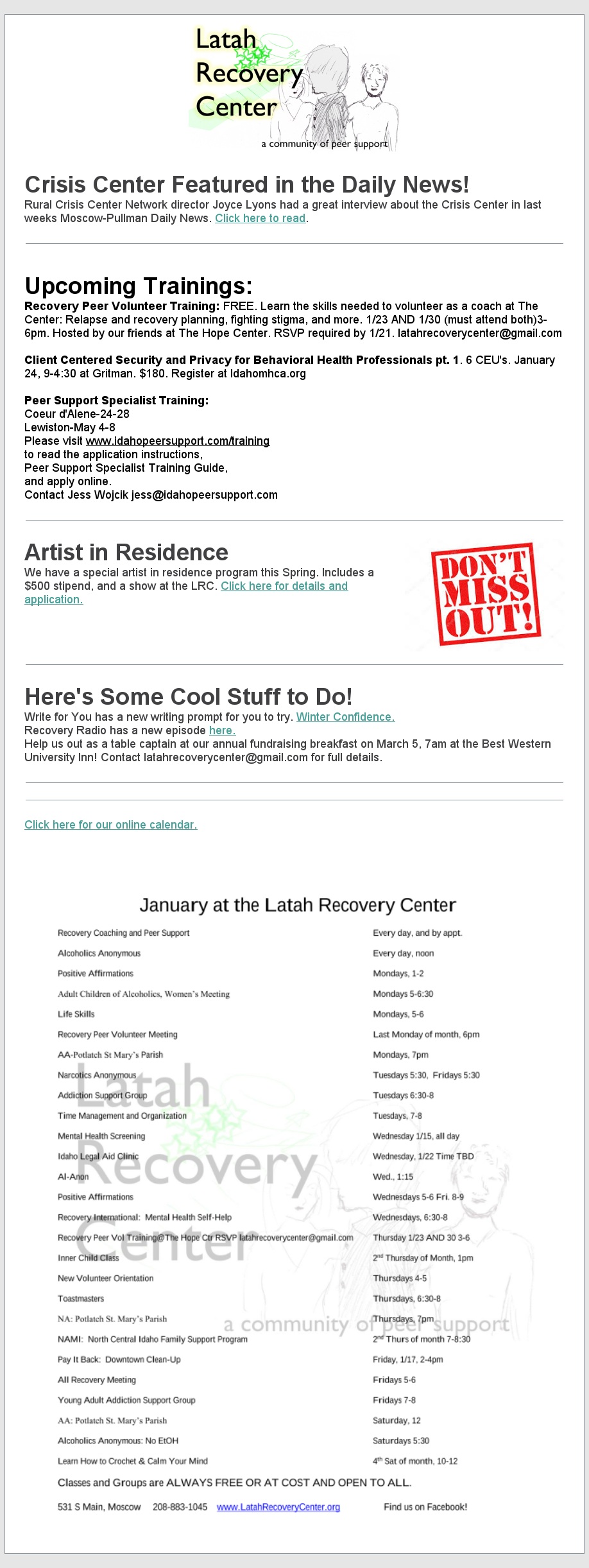
In the News
Easy Go
by Nancy Casey
Letting go can be really hard. It can also be really easy. Today you will write about some of your experiences where letting go was really easy.
Set up your page, leaving space for a title and some illustration. You can draw or doodle in the illustration space while you think about what to write, or fill it up somehow later.
The literal, physical idea of letting go means that you had something in your hand, but it’s not there anymore. Maybe you dropped it, or put it away. You might have thrown it as part of a game, or handed it to someone else. You pick something up. When you put it down somewhere else, you’ve let go.
Trouble is, if you let go of something easily, it’s likely you don’t even remember it! That can make it hard to come up with things to write down.
One way to jog your memory of what you have let go of easily, think about objects you have picked up or held in your hand—today, this week, this year, in your life. Which ones were easy to let go of? Are they the ones you hardly remember handling?
A person lets go of a plate after they put it back on the shelf. We let go of objects when we drop them into purses or pockets. A lot of people let go of stuff the instant they walk into their homes—satchels, packs, bags of groceries. Keys, mail, hats and gloves.
Not all objects are easy to let go of, but a lot of them are.
When we forget something, we have let go of a thought or an idea. If you read something and don’t remember it later, that’s a sign that whatever you read was easy for you to let go of. If you forget to run an errand, you must have let go of its importance with no effort at all.
Today, write about occasions when letting go is so effortless you hardly know you do it. Write sentences that start out, “It’s easy to let go of…” or “It didn’t take any effort to let go of…” You can add more information with phrases that begin with “when” or “because.” Explain anything that you would like about the ease of letting go.
When the page is full, go back over your work. Make small changes if you need to. Add some color or decoration to the page if you haven’t already. When you are satisfied with the page, give it a title and write the date on it, too. Here is an example of what someone could write.
You can share your work by posting it as a comment below. You can type it in, or take a photo of it and upload the image.
Nancy Casey has lived in Latah County for many years. You can find more of her work here. She taught the Write-For-You writing class at the Recovery Center last summer and will return again in the spring. For more information about classes and writing certificates, contact Nancy or the Latah Recovery Community Center.
Winter Confidence
by Nancy Casey
After a couple of months of winter, it becomes apparent that there are quite a few things you are good at.
People who enjoy the snow and the cold often become good at sporty and fun activities, such as skiing and sledding or making snow people. Some of them are even good at laughing when they fall down and get snow down their backs.
You don’t have to love the winter conditions to be good at dealing with them, though. Shoveling snow, walking on ice, thawing frozen pipes, scraping off a car, and dressing for the cold aren’t known for their universal appeal. Many people are annoyed and inconvenienced by activities like these. At the very same time you can still be good at them.
Today, write about your winter skills. Think about the tasks and activities that winter brings into your life. Set aside all judgements about whether you like them or not and ask yourself which ones you approach with confidence.
With that question in mind, set up your page. As always, begin with a line at the top that will reserve a spot for your title. Then draw some kind of random shape in the middle of the page. Next draw some lines or curves that radiate out from that shape and reach the edge of the paper. Now your writing space is divided up into sections.
In each section, write something that begins, “It’s winter and I am good at…” Then tell something about one of your winter skills. As much as you can fit into that section. Then move on to another section and another skill.
You can always use one or more of the sections as a drawing or doodling space if you feel like it.
When all the sections are full, go back over your work. Make small changes if you need to. Add some color or decoration to the page if you haven’t already. When you are satisfied with the page, give it a title and write the date on it, too.
Here is an example of what someone could write.
You can share your work by posting it as a comment below. You can type it in, or take a photo of it and upload the image.
Nancy Casey has lived in Latah County for many years. You can find more of her work here. She taught the Write-For-You writing class at the Recovery Center last summer and will return again in the spring. For more information about classes and writing certificates, contact Nancy or the Latah Recovery Center.
This Week at the LRC 1/20/2020
Recovery Radio 1/2/20
Oh the Gifts!
by Nancy Casey
Imagine yourself with unlimited power and unlimited wealth. That means you could acquire everything that money can and can’t buy. Imagine the gifts you could give!
You could give gifts to your friends and enemies. You could give them to plants and animals. You might think a new cushion would be a nice gift for a chair. A house might appreciate the gift of a new roof. Maybe you prefer to give gifts to yourself.
Your gifts don’t have to be tangible. Because you are so powerful, you can bestow gifts like confidence, or the ability to play the piano. You can change the past and bend the future. What gifts might you give that would do that? Who would you give them to?
Today in your writing, imagine yourself as a great giver of gifts.
Before you begin to write, set up your page. Draw a line at the top where the title will go. Set off any size space for illustration or doodling. You can fill up that space first while you are thinking up what to write. Or you can fill it up after you have finished writing, while you wait for a title to pop into your mind.
Then begin to write. You could start with a sentence that has the form:
To _____ , I would give the gift of _____.
After that you can add other information, such as what the gift will change, how the receiver of the gift will react, or the history of the gift itself.
You might have so much to say about one single gift that you fill up the whole page explaining it. Or you might think up so many gifts to give that you can only write a few words about each in order list them all.
When the page is too full to hold any more gifts, go back over your work. Make small changes if you need to. When you are satisfied with the page, give it a title and write the date on it, too. Here is an example of what someone could write.
You can share your work by posting it as a comment below. You can type it in, or take a photo of it and upload the image.
Nancy Casey has lived in Latah County for many years. You can find more of her work here. She taught the Write-For-You writing class at the Recovery Center last summer and will return again in the spring. For more information about classes and writing certificates, contact Nancy or the Latah Recovery Community Center.
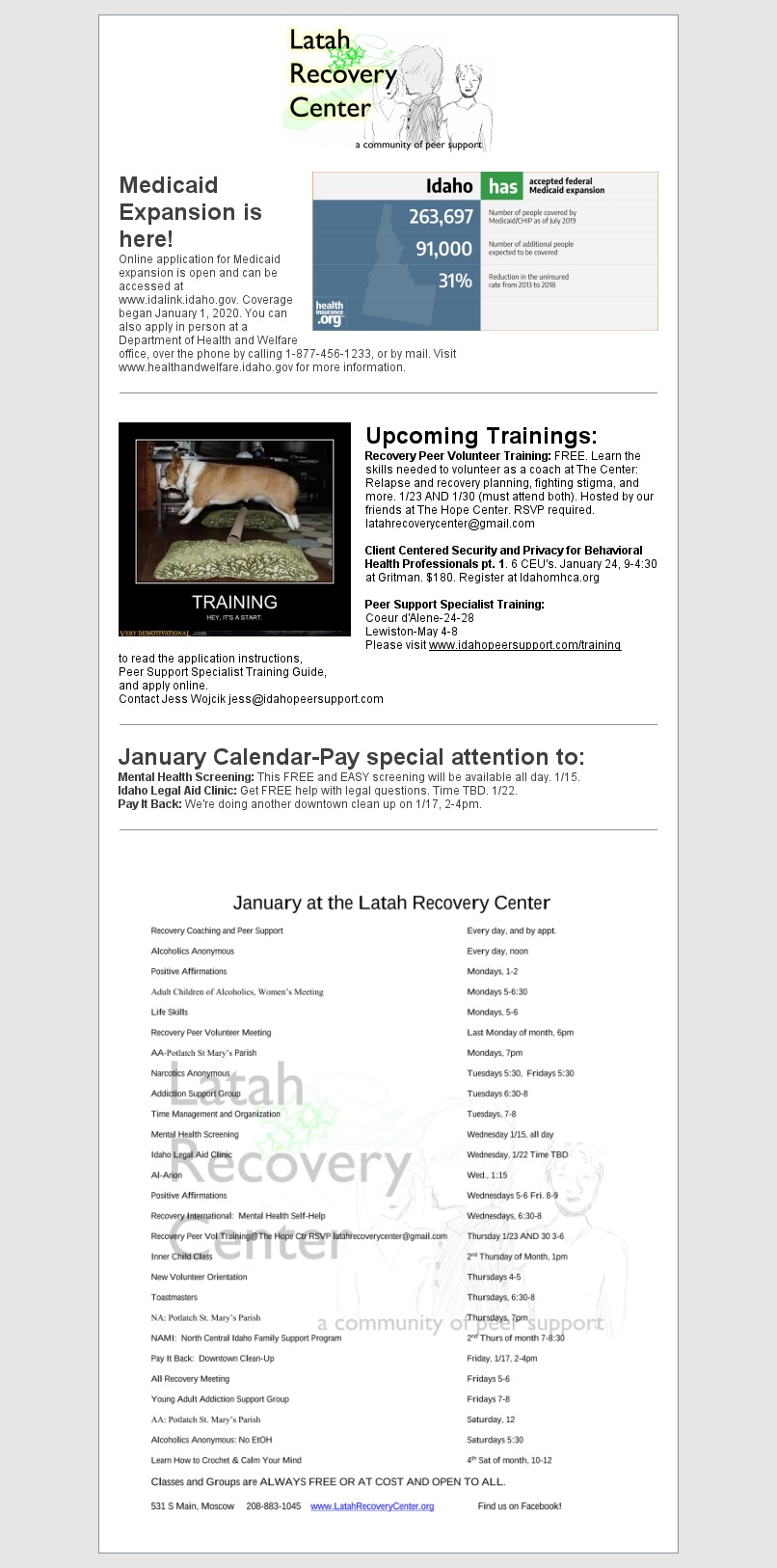
This Week at the Latah Recovery Center
The Long and the Short of It
by Nancy Casey
Anything that is short can also be long. And vice-versa. It depends on our perspective, and we can change our perspective at will.
Today in your writing, ask yourself, “What, in my experience, is both long and short?”
You can think about distances. Destinations, for example, get closer and farther away depending on whether we are walking or riding in a car. “A short ways ahead” means something different to a parent and an impatient child. The same hairstyle or hemline can be considered long or short in different circumstances.. Tools and other objects can seem long or short depending on the person using them or the place they are being used.
Anything involving time can be perceived as long or short. Sometimes yesterday feels like an eternity ago, and a childhood event can seem like it happened “just yesterday.” Whether an activity takes a long or a short time might have a lot to do with whether the person is enjoying it or not.
Stories can be long or short. “Today I saw my friend.” That story is short. “Today I saw my friend who…” That’s the same story, but it could turn out to be very long. Sometimes a person will offer to “make a long story short”—and then tell you a long story anyway. Have you ever done that? Why is it hard sometimes to make a long story short? Have you ever tried to make a short story longer?
Look at the world around you. Explore your memory and imagination. When you notice something that you would call “long,” ask yourself when you might consider it short. When you notice that something is short, ask yourself how a change of context or perspective would make it long.
Write about something—or many things—which, in your experience, have been both long and short.
When the page is full, go back over your work. Make small changes if you need to. Add some color or decoration to the page if you haven’t already. When you are satisfied with the page, give it a title and write the date on it, too. You can even ask yourself whether writing the page itself took a long or a short time.
Here is an example of what someone could write.
You can share your work by posting it as a comment below. You can type it in, or take a photo of it and upload the image.
Nancy Casey has lived in Latah County for many years. You can find more of her work here. She taught the Write-For-You writing class at the Recovery Center last summer and will return again in the spring. For more information about classes and writing certificates, contact Nancy or the Latah Recovery Community Center.
January at the LRC!

Skip into the New Year
by Nancy Casey
One of the traditions of this season is to look ahead to the coming year and think about what it’s going to hold. There’s a whole imaginary year ahead of us. We can imagine it any way that we want.
People talk of making resolutions, setting goals, and changing their schedules. Not all your New Year’s thoughts need to be about discipline and resolve, though.
Today in your writing, as you think about the imaginary year ahead, ask yourself, “What shall I just skip?”
Imagine yourself skipping everything that you find tiresome or unpleasant. What don’t you want? Go ahead and skip all that. What kinds of experiences would you rather do without? Skip them, too.
Consider each of your five senses. What will you skip seeing? What won’t you hear? What foods, when offered, will make you say, “No thank you.” What trip won’t you take? When will you plug up your nose?
Think about the infinitely many ways you could finish a sentence that begins, “I will skip…”
Before you start to write, set up your page. Draw a line across the top where you will put a title after you have finished writing. Set aside some space for illustration or doodling. Drawing and doodling will keep your pen moving on the page while you are thinking up something to write.
On the first line, write the words, “I will skip…” and finish the sentence by naming something you will (or would like to) do without this year. You can explain as much or as little as you would like about it. Then begin a new sentence with “I will skip…” and continue down the page in this way.
When the page is full, go back over your work. Make small changes if you need to. Add some color or decoration to the page if you haven’t already. When you are satisfied with the page, give it a title and write the date on it, too. Here is an example of what someone could write.
You can share your work by posting it as a comment below. You can type it in, or take a photo of it and upload the image.
Nancy Casey has lived in Latah County for many years. You can find more of her work here. She taught the Write-For-You writing class at the Recovery Center last summer and will return again in the spring. For more information about classes and writing certificates, contact Nancy or the Latah Recovery Community Center.
 Latah Recovery Community Center, Inc.