In the News

Write for You: Using Writing Prompts

By Nancy Casey

Imagine a ball sitting still on top of a hill.  With a simple nudge it will begin to roll.  Or maybe, if it sits there long enough, a breeze will get it moving before it goes flat and turns into litter.  Your mind can be like that ball when you are trying to decide what to write about.  You sit up there with a tremendous view–your experience, your ideas, the truths, the falsehoods, the people, the stories.  Thinking about all the things you could write about is enough to keep you from writing anything at all.

A writing prompt is the nudge that gets you going.  In one direction or another.  It doesn’t matter which direction.  It’s always an interesting ride.

A writing prompt is a set of instructions.  It sounds like an assignment, the kind you might get in school, but it’s different.  If you don’t follow the instructions, nobody will say you did it wrong.  If you nudge the ball and after it begins to roll, it bumps a rock and bounces off in another direction, you don’t tell the ball it doesn’t know how to roll.  If the ball bumps a rock and sails away to land on a different hilltop, you wouldn’t tell the ball to quit being silly, pay attention, start over and do it right.

Many writing prompts take the form of a fill-in-the-blank sentence.  Here is one you can try today:  Some people have [blank] but I have [blank].

Don’t plan ahead what to say.  As you write, “Some people have” relax your mind and watch the words spill from the end of the pen. Whatever idea floats into your head, use that. It can be long or short.  Then you have to add something about what you have.  Again, don’t plan, just watch the words “but I have” roll onto the page and write whatever comes into your head next. If more things come into your head, write them down, too. Then start again, “Some people have…”  You can find an example here: http://www.authornancycasey.com/prompts

Remember, however, that you don’t have to follow the directions.  Your mind has a mind of its own. You might start to write about a particular thing that you or other people have and find out you have so much to say about it that you run out of ink, paper or time before you finish. You can even write, “I don’t care what anybody has, today I am going to write about…”  Or just ignore the prompt altogether.  What’s always most important is that you write something.  If the prompt seems dumb, but you can’t think of anything else to write, use the prompt.  What you write won’t be dumb.

Play with this writing prompt a couple more times this week.  Here are some ways you can change it around:

·         Instead of beginning with “some people”, begin with a plant, an animal or an object.  Trees have…  My dog has… Bricks have… The internet has… 

·         Turn it inside out:  Some people don’t have….., but I don’t have….

·         Change “have” to something else.  Some people like…  Some people eat…  Some people want…

·         Reread what you have written using this writing prompt and write about what it makes you think.

When you are finished, make sure the date is somewhere on the page and give it a title.  Decorate the page as needed. 

Pay attention to your writing hand.  Is it tired?  Does it hurt?  Where? Don’t punish a hard-working hand by shaking it or pressing your thumb into a spot that hurts.  Lay your hands on the table and gently roll your shoulders.  Think about that ball sitting on the top of a hill ready to go in any direction.  As you wait for the pain and tension in your hands to dissipate, imagine yourself sitting next to that ball.  Imagine the view.

Nancy Casey is a writer and teacher who has lived in rural Latah County for many years.  You can see more of her work at http://www.authornancycasey.com

If you like the idea of writing every week, but want to do it with others in a class setting, you are welcome to attend “Writing Journeys” with Ginger Rankin on Wednesdays from 4-5 at the Latah Recovery Center.  The class does exercises from this blog and other things as well.

February at the Latah Recovery Center

Our February calendar is out now.  See below.
We are still looking for table captains for our March fundraising breakfast.  If you want to enjoy a good free (tho we’re going to ask you to make a donation to support The Center) breakfast with several of your friends, email Darrell latahrecoverycenter@gmail.com for the full details.  Your help is much appreciated!
The deadline for registering for Mental Health First Aid is 1/25.  Class is 2/1 and 2, 4-8pm. Register at marketplace.uidaho.edu.  The Center has a small number of scholarships available for our volunteers.  Contact Darrell if wanting a scholarship.
This weeks special offerings at The Center:
1/27 and 1/30 2-5pm Moscow Point In Time Count.  If you know someone homeless sen them to The Center We’ll have some food, and will count everyone that shows up.  What is this, you ask?  Every year the gov’t asks each state to attempt counting all the homeless people in the state.  Aid is then apportioned according to that count.  This is a local part of that program.
1/28 Learn to Crochet and Re-Wire Your Brain 10-Noon.

February at the Latah Recovery Center

Alcoholics Anonymous                                                  Every day, noon

Positive Affirmations                                                     Mondays and Weds 1:10-2

YOU Can Create Your Own Job                                    Monday 2/6, 6

Life Skills                                                                       Tuesdays 5-6

Chess w/Steve                                                                Tues and Thurs 5-6

LRC Board of Directors meeting                                    Tuesday 2/7, 4-5:30

Cultural Competence in Recovery Coaching: Video      Tuesday 2/7, 2-3

Anger Management w/Doug Salada                               Tuesday 2/21, 6

Writing Journeys w/Nancy and Ginger                          Wednesdays, 4-5

Recovery Peer Volunteer Training (RSVP by 2/13)      Wed. 2/15 (LRC) and 2/22 (@NPRRC)

Mental Health First Aid                                                 Wed 2/1 and Thurs 2/2, 4-8

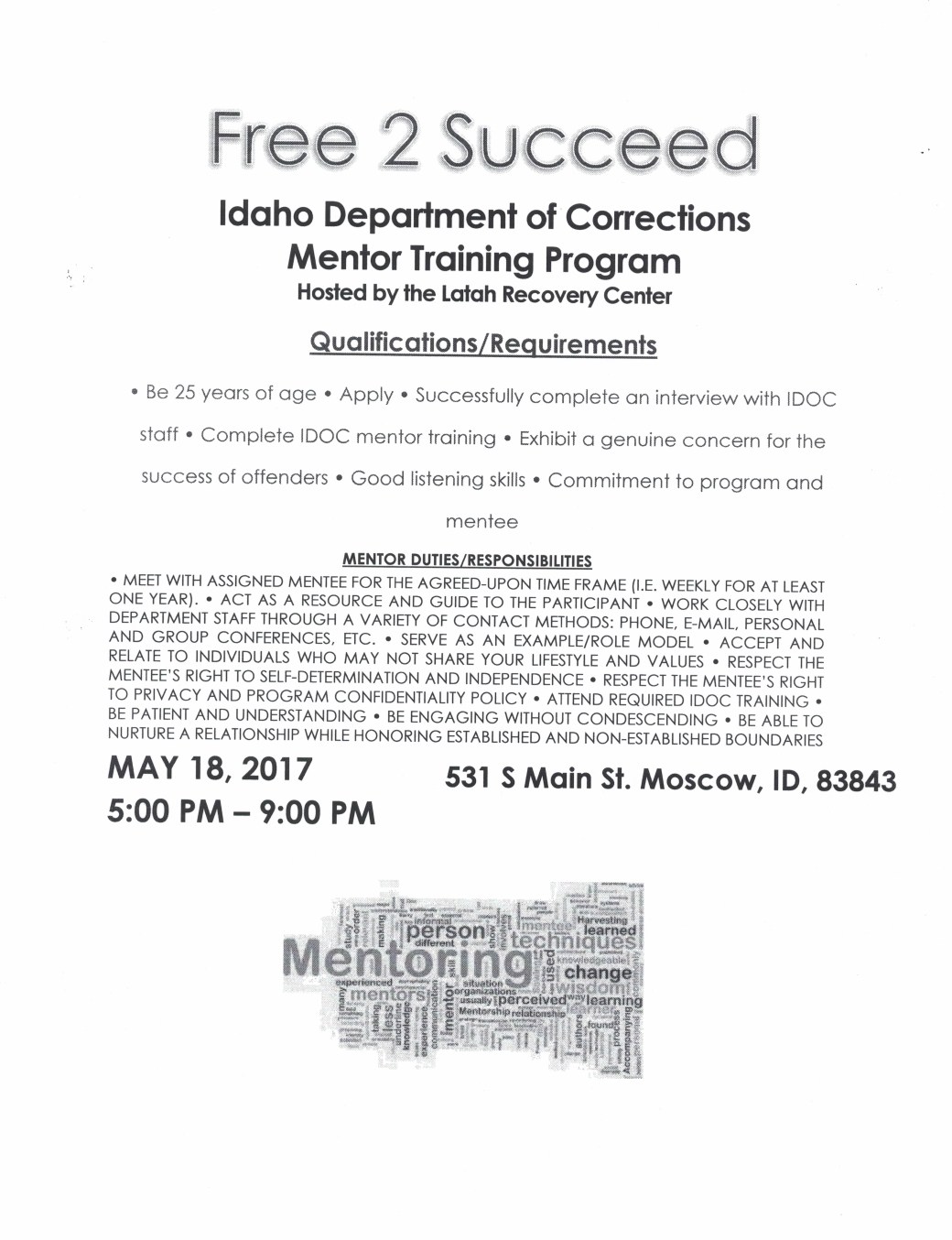
Free 2 Succeed:  IDOC Mentor Training (RSVP by 2/21)       Thurs. 2/23, 5-9 (@NPRRC)

LAMI:  Family Support Program                                   2nd Thurs of month 7-8:30

Knitting and Spinning                                                    Fridays 2-5

All Recovery Meeting                                                     Fridays 5-6

Movie/Games:                                                                 Fridays 6:30-9

AA Speakers Meeting                                                    3rd Sat of month 11-2:30

Learn to Crochet & Rewire your Brain                          4th Sat of month, 10-12

Adult Children of Alcoholics, Women’s Meeting          Sundays 6-7:30 

Classes and Groups are ALWAYS FREE OR AT COST AND OPEN TO ALL. 

Please RSVP LatahRecoveryCenter@gmail.com

Bolded=Regular offering.  Plain text=Special offering for month.

Need an understanding person to talk to?  We have Recovery Peer Volunteers here to help you in recovery from mental health and addiction issues all hours of operation. We are here to help!

Write for You: Your Precious Hands

By Nancy Casey

Before you begin to write today, walk around. Pick up a few objects and set them back down again. As you do so, notice your hands. How do they know what to do? Watch how your fingers get ahold of something tiny, like a coin. When you pick up something a little bit heavy, notice how your hand grips it, each finger holding on the exact right place and the exact right amount.

Sit down and lay your forearms on the empty surface of a table. Turn one palm up and the other one down. Then rotate your wrists gently left and right and roll your hands back and forth so one palm turns up as the other one turns down. Don’t stretch. Let them flop. Move the rest of your body a little bit, too.

As your hands move on the table in front of you, think of the many things a pair of hands can do. We use them to operate zippers, cars and snowshovels. Hands know how to catch, throw, point, scratch, and wave.

Drum your fingers on the table. Watch them go. Pretend your fingers are little people and let them walk across the surface. Float your hands in front of your face. Wiggle your fingers and watch them do tricks.

Imagine the insides of your hands. Such little bones! A knuckle is such a tiny thing compared to a knee. The muscles, ligaments and tendons in there must be as skinny as strings, yet they connect and criss-cross like complicated machinery.

Your precious hands. They have been working for you all your life. Helping you get what you want. Helping you hold onto it. You never even have to tell them.

When your hands hurt, you probably make them do things anyway. Most people do. Now you are asking them to do this writing thing. There has to be a way to do it without making your hand cramp or ache.

Take up your pen and write about what your hands have already done for your today. What have they touched? What have they brought? What have they made? What have they told you?

As you write, do not allow your hand to experience any discomfort. If it feels tired, or begins to hurt, write bigger, or sloppier. Hold the pen with different fingers or in your fist. Change the way you are sitting. Use pillows. Write with the opposite hand. Make a mess of the page if that’s what it takes to fill it with writing without straining your hand.

When you have finished, put the date somewhere on the page and give it a title. For an extra touch, lay your hand down on the page and trace it. You can see an example here: http://www.authornancycasey.com/precious-hands

Throughout the week, pay attention to hands—yours and other people’s. Collect details that your can write down later. Notice what hands do and how they do it. Notice what they look like—bumps and bruises, veins and fingernails. Pay attention to what people say about their hands.

When you write this week, make it all about hands. Begin by doing something kind and relaxing with your own hands. Recall some of the hands you have noted in your daily life. Write about them. As you write, do whatever it takes to make sure your hand never hurts.

Tell yourself this—
No pain.
No pain.

Nancy Casey is a writer and teacher who has lived in rural Latah County for many years. You can see more of her work at http://www.authornancycasey.com

If you like the idea of writing every week, but want to do it with others in a class setting, you are welcome to attend “Writing Journeys” with Ginger Rankin on Wednesdays from 4-5 at the Latah Recovery Center. The class does exercises from this blog and other things as well.

This Week at the Latah Recovery Center

Would you like to know how to identify and assist someone in mental health crisis?  Our upcoming Mental Health First Aid course is for you!  Topics include anxiety, depression, psychosis and addictions.  Cost is $25.  The Latah Recovery Center has made a limited number of $12.50 scholarships available to our registered volunteers and full scholarships to our Recovery Peer Volunteers.  Contact latahrecoverycenter@gmail.com to find out how to register or to apply for a scholarship.
The next post in our Write For You blog is up:
Needed:  Table Captains.
We are looking for table captains for our March 8, 7am Fundraising Breakfast.  If you’d like to help The Center AND have breakfast with your friends at the University Inn, contact Darrell (latahrecoverycenter@gmail.com) to see how it works.

January at the Latah Recovery Center

Alcoholics Anonymous                                                  Every day, noon

Positive Affirmations                                                     Mondays and Weds 1:10-2

Moscow Gathering 2017 Point in Time Event               Monday 1/30, 2-5

YOU Can Create Your Own Job                                    Monday 1/2, 6

Life Skills                                                                       Mondays and Tuesdays 5-6

Chess w/Steve                                                                Tues and Thurs 5-6

LRC Board of Directors meeting                                    Tuesday 1/10, 4-5:30

Recovery Coaching:  Burn out/Self-Care Webinar                   Wednesday 1/11, 10

Writing Journeys w/Nancy and Ginger                          Wednesdays, 4-5

LAMI:  Family Support Program                                   2nd Thurs of month 7-8:30

Knitting and Spinning                                                    Fridays 2-5

Moscow Gathering 2017 Point in Time Event               Friday 1/27, 2-5

All Recovery Meeting                                                     Fridays 5-6

Movie/Games: Puss in Boots, Big, Good Dinosaur, The Toy, How to Train Your Dragon    Fridays 6:30-9

AA Speakers Meeting                                                    3rd Sat of month 11-2:30

Learn to Crochet & Rewire your Brain                          4th Sat of month, 10-12

New Years Eve-Hobbit Movie Marathon and Potluck  12/31, 1pm to 1/1, 11am

Adult Children of Alcoholics, Women’s Meeting    Sundays 6-7:30 

MARK YOUR CALENDAR FOR MENTAL HEALTH FIRST AID 2/1-2, 4-8pm at the Pittman Center on campus.  Cost is $25.  Email latahrecoverycenter@gmail.com for registration details.

Classes and Groups are ALWAYS FREE OR AT COST AND OPEN TO ALL. 

Please RSVP. Bolded=Regular offering.  Plain text=Special offering for month.

Need an understanding person to talk to?  We have Recovery Peer Volunteers here to help you in recovery from mental health and addiction issues all hours of operation. We are here to help!

Write For You: Before That

What are you doing right now?

Reading this?  Wondering what you will be writing? Sitting crooked?  Worrying?  Noticing that the sky is turning pink? 

You can answer a question like that in a zillion ways.  Whatever your answer is, write it down.

On the next line, write “Before that…” and write down what you did before that.

Then on the next line (you guessed it) write “Before that….” Write down what you did before that and keep going so that each thing you write down jumps backwards in time from the one before.  Fill up a page—or more.  This is an especially good exercise to do on a day where the ogre in your head is calling you lazy or accusing you of “doing nothing.”  It’s funny how you can think you’ve “done nothing” all day when really you’ve simply forgotten all that you’ve done.

You can write short things or long things, one word or a whole page.  You can skip back one nanosecond in time, or 3,000 years.  If you skip back to the Big Bang and describe what happened before that, nobody can say you got it wrong.

Try not to plan it all out ahead of time.  Don’t commit to what you are going to put down until you are writing “Before that”.  In fact, if you think you know what you are going to write and something new comes into your head while you are forming the letters of “Before that,” write that new thing down instead.

When you have finished, go back and read it all over.  Add things if you need to.  Put the date somewhere on the page and give it a title.  If it seems like there is a lot of empty space on the page, fill it with doodles or find a picture and tape or glue it onto the paper.

You can find an example of what you can do here:  http://authornancycasey.com/before-that/

Do this exercise a couple of more times during the week.  Here are some ways you can change it up:

·         Don’t write about yourself.  Instead of beginning with what you are doing, begin with something nearby—a person, an object, a plant, a pet—and say what they are doing instead.

·         Add lies.  You can slip in a single false detail, or you can make everything false from beginning to end.  Or to really twist up your mind, alternate between telling the truth and lying with each line.

·         Start at some point in the future and end in the present.

·         Go back to a “Before that” exercise you have already done and add things to it to make it twice as long.

At this point in your writing practice, you have likely assembled an impressive little sheaf of pages.  Go through them and make sure they are in order—whatever kind of order seems good to you.

If you are doing your writing practice on an electronic device (tablet, phone, computer, etc.) print the pages off.  (And back them up!) There’s just no substitute for handling and admiring the physical pages of your work.  Do something to the pages to turn them into something done by a human, not a machine—draw a border, add some artwork, write jokes to yourself in the margin.

If the whole sheaf of pages had a title, what would it be?

Nancy Casey is a writer and teacher who has lived in rural Latah County for many years.  You can see more of her work at http://www.authornancycasey.com.

If you like the idea of writing every week, but want to do it with others in a class setting, you are welcome to attend “Writing Journeys” with Ginger Rankin on Wednesdays from 4-5 at the Latah Recovery Center.  The class does exercises from this blog and other things as well.


This Week at the Latah Recovery Center

We are very pleased to have Nancy Casey, one of our writing group facilitators, writing a blog post for us this week.  https://latahrecoverycenter.org/2017/01/09/write-for-you-the-opposite-game/
Have you read the terms “Recovery Coach,” “Peer Specialist,” and “Recovery Peer Volunteer” and wondered what they are?  Here’s your chance to find out!
Without further ado-Here is what’s happening at The Center:

January at the Latah Recovery Center

Alcoholics Anonymous                                                  Every day, noon

Positive Affirmations                                                     Mondays and Weds 1:10-2

Moscow Gathering 2017 Point in Time Event               Monday 1/30, 2-5

YOU Can Create Your Own Job                                    Monday 1/2, 6

Life Skills                                                                       Mondays and Tuesdays 5-6

Chess w/Steve                                                                Tues and Thurs 5-6

LRC Board of Directors meeting                                    Tuesday 1/10, 4-5:30

Recovery Coaching:  Burn out/Self-Care Webinar                   Wednesday 1/11, 10

Writing Journeys w/Nancy and Ginger                          Wednesdays, 4-5

LAMI:  Family Support Program                                   2nd Thurs of month 7-8:30

Knitting and Spinning                                                    Fridays 2-5

Moscow Gathering 2017 Point in Time Event               Friday 1/27, 2-5

All Recovery Meeting                                                     Fridays 5-6

Movie/Games: Puss in Boots, Big, Good Dinosaur, The Toy, How to Train Your Dragon    Fridays 6:30-9

AA Speakers Meeting                                                    3rd Sat of month 11-2:30

Learn to Crochet & Rewire your Brain                          4th Sat of month, 10-12

New Years Eve-Hobbit Movie Marathon and Potluck  12/31, 1pm to 1/1, 11am

Adult Children of Alcoholics, Women’s Meeting    Sundays 6-7:30 

MARK YOUR CALENDAR FOR MENTAL HEALTH FIRST AID 2/1-2, 4-8pm at the Pittman Center on campus.  Cost is $25.  Email latahrecoverycenter@gmail.com for registration details.

Classes and Groups are ALWAYS FREE OR AT COST AND OPEN TO ALL. 

Please RSVP. Bolded=Regular offering.  Plain text=Special offering for month.

Need an understanding person to talk to?  We have Recovery Peer Volunteers here to help you in recovery from mental health and addiction issues all hours of operation. We are here to help!

What are Recovery Coaches, Peer Specialists and Recovery Peer Volunteers?

Have you read the terms “Recovery Coach,” “Peer Specialist,” and “Recovery Peer Volunteer” and wondered what they are?  Here’s your chance to find out!
A Recovery Coach is someone that is successfully dealing with an addiction issue, and has taken a 50+ hour curriculum of coaching and ethics training. In Idaho, a Recovery Coach may or may not be certified.  Certified coaches have completed additional steps-internship time and a test-through the Idaho Board of Alcohol/Drug Counselors Certification.  In short, a Recovery Coach is a trained person with lived addiction experience that is here to help others as they struggle with their addiction issues.
A  Peer Specialist is very similar to a Recovery Coach in amounts of training and experience required.  However, they have lived experience with a mental health issue, and are here to help others with such.
At the Latah Recovery Center we also have “Recovery Peer Volunteers.” These are volunteers with lived experience that have taken a six hour “highlights” training that goes over many of the topics in the Recovery Coach and Peer Specialist trainings.  These volunteers must then pass a board of review testing their knowledge, and are then closely overseen by our Recovery Peer Program Coordinator, a person that has taken both Recovery Coach and Peer Specialist trainings, and has lived experience with both.
How is that working, you ask? Judge for yourself:
1.  Participants in our program show a 2% improvement in Quality of Life after 9 months of coaching.  This seems small, but is actually good.  Many people actually see a decrease in quality of life when they first enter recovery.  This is frequently due to job loss, loss of friends, family and others as they transition away from their addictions.
2.  Recovery Capitol improves by 9% over that same time period.  Recovery Capitol is the “tools” in a persons toolbox.  Increased recovery capitol means they have more tools:  leading to less likelihood of remission and shorter remission periods.
3.  Physical wellness increases by 13% over that same 9 month period.
For our full report click below.

Write For You:  The Opposite Game

By Nancy Casey

What is the opposite of tiny?

What is the opposite of floor?

What is the opposite of doorbell?

If you approach those three questions like they are a math problem, you might say that the first two are easy and the third one leaves you stumped.  When you play the Opposite Game, you will come up with opposites for many different words.  So you must use a loose definition of “opposite.”  Think of “opposite” as “somehow related, but definitely not the same.”

So what’s the opposite of doorbell?  Door knocker? Lonely? Dong-ding? Silence?…..

When you play the Opposite Game, the words that you come up with only have to make sense to you.  For instance, if you have a water stain on your ceiling from when the roof leaked six years ago, you might say that the opposite of “floor” is “water stain” or “grey blob.”  (Of course, you could also simply say “ceiling.”)

Here’s how you play:  Start with a word, any word at all.  (If you can’t decide on a word, start with “daylight.” ) Declare its opposite.  Then give the opposite of that word.  Write it all out carefully.  End up with a meandering chain of opposites that fill up a page.  Here’s an example that starts with “tiny.”

The opposite of tiny is huge.

The opposite of huge is a flea.

The opposite of a flea is a dog.

The opposite of a dog is “meow.”

The opposite of “meow” is…..

You can see a longer example here:  http://authornancycasey.com/opposite-game

It’s really important that you write out all the words carefully, even though it seems you’ll write “opposite” about a zillion times.  Enjoy the round, round O, the double P.  Cross the T with careful purpose.  Try to write steady and even.  Find a pace that is pleasant and won’t give you a hand cramp.  Relax into the repetition.  Instead of “thinking up” what to say next, listen for what pops into your head and use that.  You can’t get it wrong.  Enjoy wherever the wandering path of opposites takes you.

Keep writing opposites for at least one full page.  (Hint:  If that seems like too many, write bigger.)  When you are finished, write the date somewhere on the page and give it a title.  If the page seems to have a lot of empty white space on it, fill it with doodles.

In additional sessions of your writing practice this week, continue to play the Opposite Game.  Here are some variations you can try:

·         Keep going until you end up with the same word you started with.

·         Notice all the places your ideas wandered when you wrote the page, and write some comments about what was surprising or interesting.

·         Notice how your mind comes up with opposites—how the ideas pop in, what makes you get stuck, whether you like or don’t like doing this, etc.  Write some comments about that.

·         If you wrote lists of everything you can see last week, take one of those lists and write out the opposites of everything on it.  (See https://latahrecoverycenter.org/2017/01/03/a-writing-practice/)

At the end of the week, put all the pages from your writing practice in order and quietly turn the pages.  Admire them.

Nancy Casey is a writer and teacher who has lived in rural Latah County for many years.  You can see more of her work at http://www.authornancycasey.com.

If you like the idea of writing every week, but want to do it with others in a class setting, you are welcome to attend “Writing Journeys” with Ginger Rankin on Wednesdays from 4-5 at the Recovery Center.


Write For You: A Writing Practice

By Nancy Casey

When you have a writing practice, you decide that you are going to do some writing.  For yourself.  To see what good it might do you.  This is not the same as “practicing” at writing with the idea of getting “better” at it.  In your writing practice, you are already good enough.

One part of having a writing practice is about commitment and discipline.  The rest is about freedom.

The commitment and discipline part is where you decide how much you are going to do and how often you are going to do it.  Just set a minimum.  You can always do extra.  Writing daily can be really beneficial, but for starting out, three pages a week makes for a good commitment.  A person can usually find the time to work that in.

As for the freedom part:  it’s freedom—enjoy!

In this blog, I will give you ideas each week for writing at least 3 pages.  There are so many different things you can do.  You will prefer some of them to others. So just stick with it and find out what you like the best—and then do more of that.

Save the pages that you write.  If you start out with loose pages in a folder, you can decide later if you want to keep your writing some other way—in a notebook or a scrapbook, for instance.  I think there are a lot of benefits to writing by hand and having actual physical pages to touch and look at.  But if you decide to write on an electronic device like a laptop or your phone, nobody is going to say you are doing it wrong.  You just might have to adapt my suggestions a little bit.

Don’t show your work to anyone for the time being.  Not because you are on a mission to write huge secrets, but because at the beginning you are finding your way.  Even when people are trying to be helpful and supportive, their comments can sometimes derail you.  After about 6 weeks, you will have more confidence and a better sense of what you are up to.  Maybe then you will want to start sharing selected pages with selected people—or not.

Here is an exercise that will allow you to write at least one page.  Do it at least 3 times this week.

Sit down somewhere with your writing materials.  Make a list of everything that you see.  Put the date somewhere on the page. Then look a little harder.  See if you can add more things to the list.  Don’t be afraid to be ridiculous.  When you are all done, give it a title. 

I like to do this with a particularly messy area of my house—kitchen counter, junk drawer, the pile of stuff on my bedroom floor—because there will be plenty of things to put on the list for sure.  But you can do it anywhere—by a window, in a restaurant, on the street, waiting for an appointment.  Sometimes the list will tell a story that only you can understand. Sometimes it’s pretty funny to read it later.  However it works out, it’s always interesting because the list gives you a detailed snapshot from your life.  You can see an example of this kind of list at http://authornancycasey.com/list-things-see-sample/

If writing the list inspires you to write more, go for it.  But remember that the only “requirement” is that you sit down at three different times this week and make these three different lists.  If you do that—bravo!—you have a writing practice.

Nancy Casey is a writer and teacher who has lived in rural Latah County for many years.  You can see more of her work at http://www.authornancycasey.com